
A 24/7 Equity Perp on Hyperliquid Liquidated $59M in Minutes
SK Hynix was a technical anomaly, but future feedback between global crypto trading and local stock markets may be harder to contain.

Our data was recently featured by Bloomberg and elEconomista.es and I thought I’d add some more color and also answer two important questions I’ve been asked this week:
Did the liquidation event on Hyperliquid move SK Hynix’s share price?
More importantly, what does this imply about the emerging two-way pattern between traditional and crypto markets?


If you’re not familiar, here’s what happened:
At 23:00 UTC on 27 July 2026, the price feed behind SK Hynix’s perpetual futures contract on Hyperliquid printed $890.14. A minute later it printed $872.25, against $1,131.40 the minute before. By 23:02 it was back at $1,144.80, above where it started1.
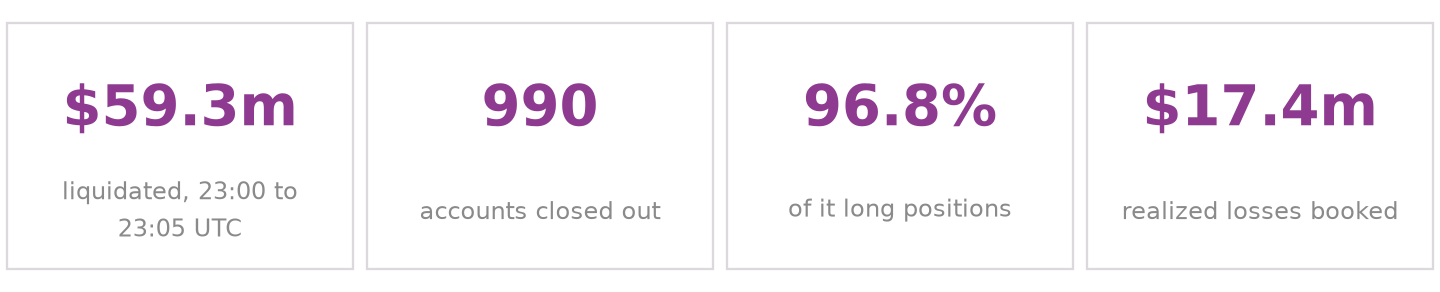
The excursion lasted two one-minute snapshots resulting in:
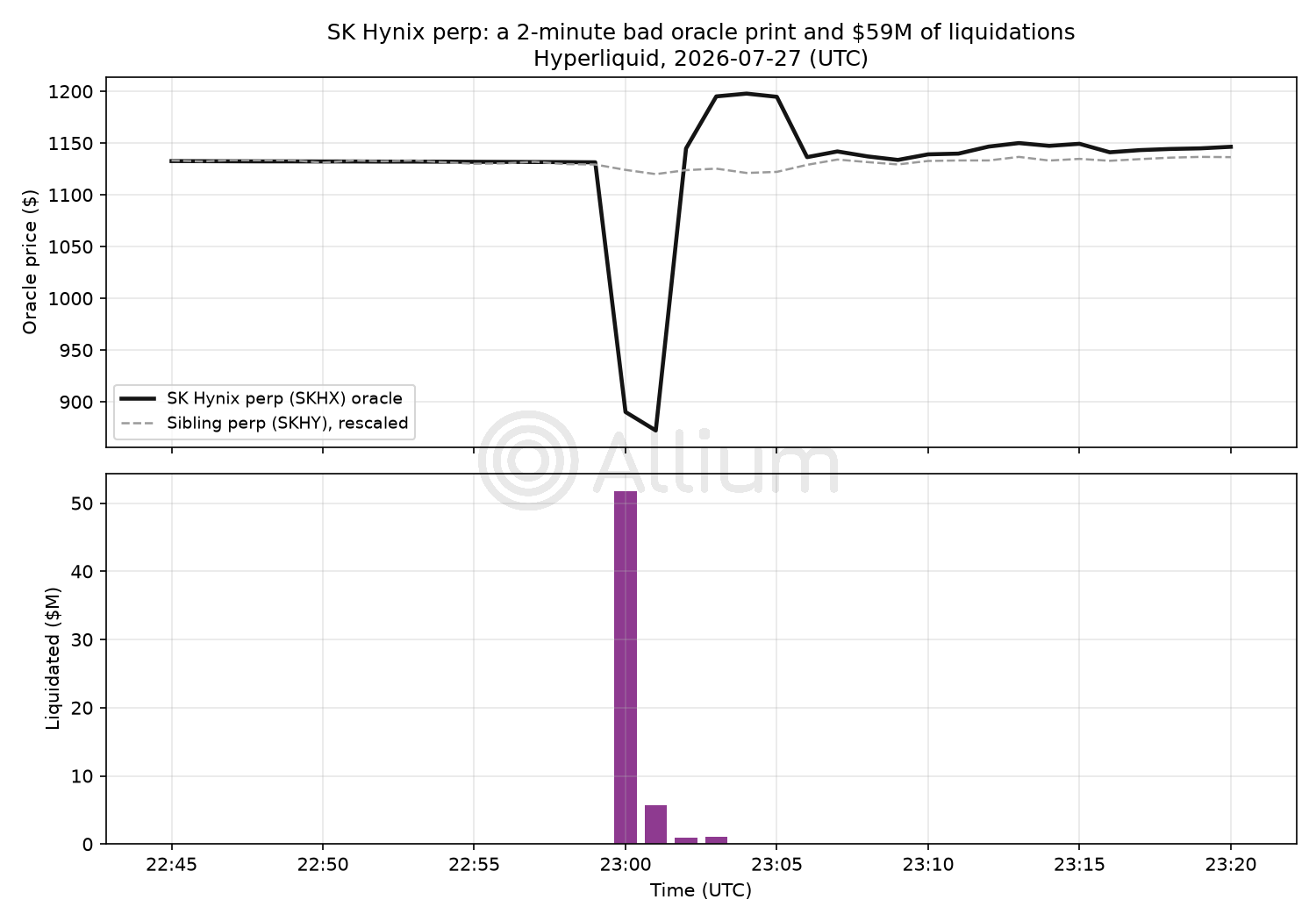
23:00 UTC is 08:00 in Seoul, so this was not the middle of the night. Korea’s alternative trading system runs a pre-market session from 08:00 to 08:50 KST, and the print landed in its opening minute. The main exchange was still shut, its opening auction does not begin until 08:30. One venue was open, and it had been open for under sixty seconds.
Trade.xyz, the deployer of the contract, said the print “was based on an executed trade relayed by multiple independent data providers.” The feed was not broken. It reported a real execution on a venue with almost no depth.
No, I don’t think the Hyperliquid event materially affected SK Hynix’s regular trading session or pushed the stock lower afterward.
Because the perpetual is cash settled, trading on Hyperliquid does not directly buy or sell SK Hynix shares. Any effect on the stock would have to come indirectly through sentiment or trading activity carrying into the Seoul market, and there is no clear evidence that happened here.
Hyperliquid traders also did not accept the bad tick as the true price.
Their orders stayed much closer to the stock’s price immediately before the bad price tick, but the margin system still used the imported price and triggered the liquidations. During Tuesday’s session, Hyperliquid’s price also stayed slightly above the Seoul price and never below it. If crypto selling had been pulling the shares down, we would expect the opposite.
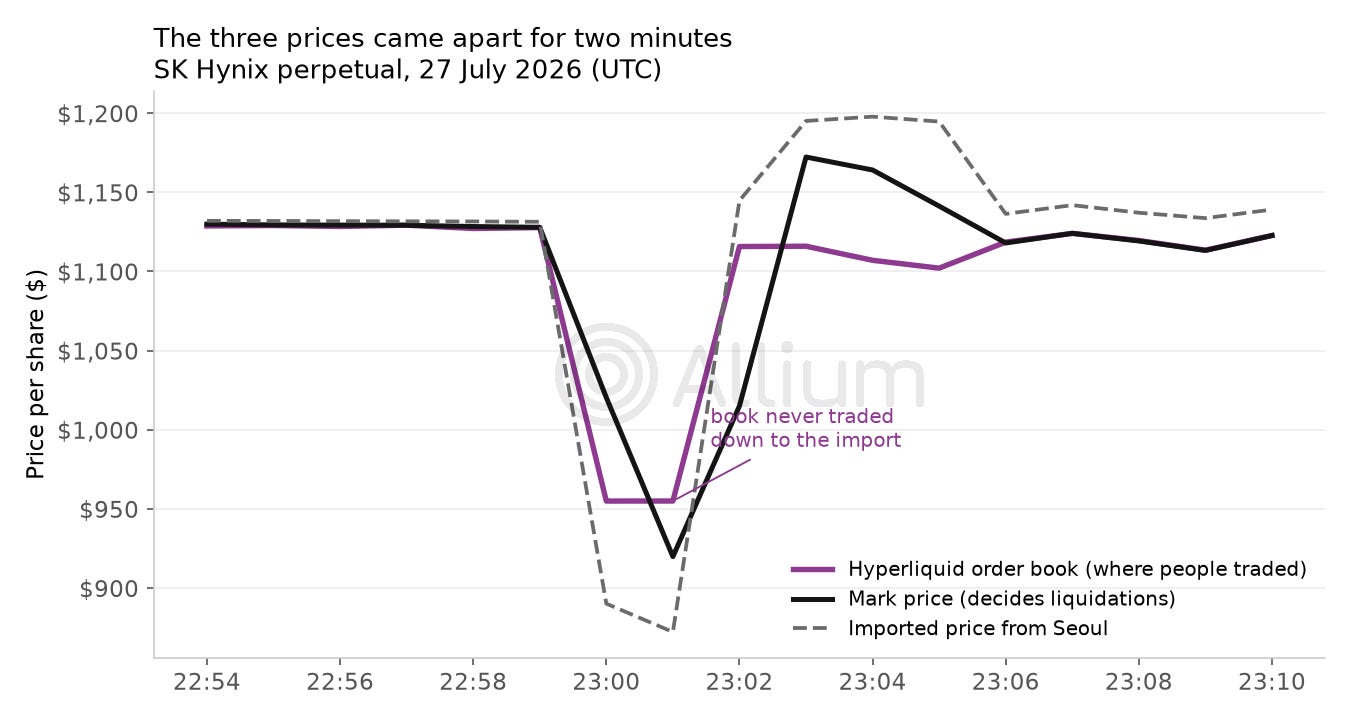
A perpetual on Hyperliquid carries three prices. The order book, where users trade each other. The imported reference price. And the mark price, used by the margin engine to decide whether a position survives, anchored to the import but referencing the book.
The book held around 9% above the imported level throughout. Mark still fell 18.4% in two minutes, and leverage on this market runs to 10x, past the wipe-out point for anything above roughly 5x.
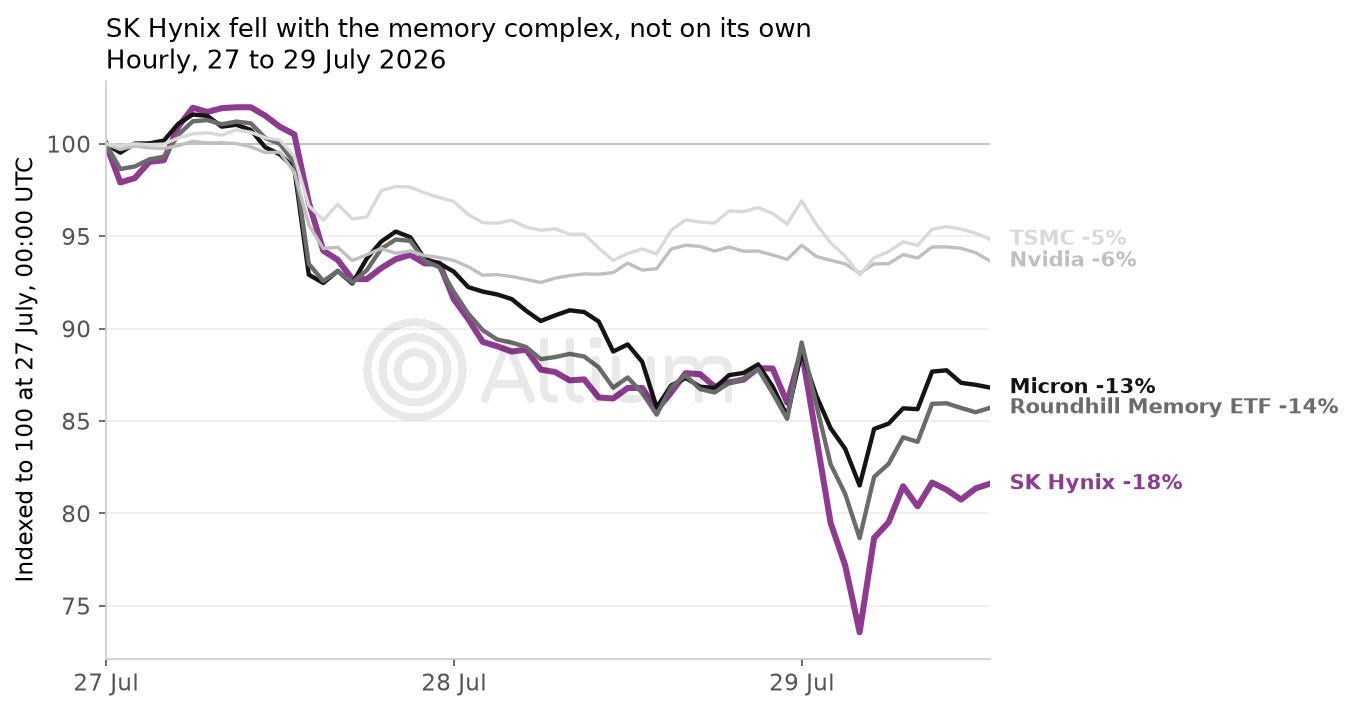
The broader move looked more like a repricing of memory stocks.
SK Hynix fell about 18% across Tuesday and Wednesday, while Micron fell 14% and the Roundhill Memory ETF fell 15%, despite neither having a comparable event on Hyperliquid. Nvidia and TSMC fell closer to 5%.
That said, major liquidations may matter more as 24/7 markets grow.
As Hyperliquid and similar venues add stocks from South Korea, Japan, China, Europe and elsewhere, global traders can build large positions while local exchanges are closed. Those positions can shape sentiment when the market reopens, while the new price action then feeds back into the 24/7 market. The Federal Reserve has described a similar two-way pattern between traditional and crypto markets, where stress can pass from one to the other and then feed back again. Over time, the two could reinforce each other and amplify a bad print, rumor or misread event before investors have time to assess what is real.
The Federal Reserve note is In the Shadow of Bank Runs (Du, Sonawane and Watsky, 17 December 2025). It finds that “the contagion can operate in both directions” and that stress in crypto “has the potential to feed back into the traditional financial sector.” The subject is stablecoins and banking rather than equities, so it is an analogy here, not a precedent.
That is not what happened here. The SK Hynix event was technical. The perp imported a real trade from a thin pre-market venue and repriced leveraged positions as designed. The perp worked as intended, but the approach to selecting and handling external price sources will need to change to avoid similar anomalies.
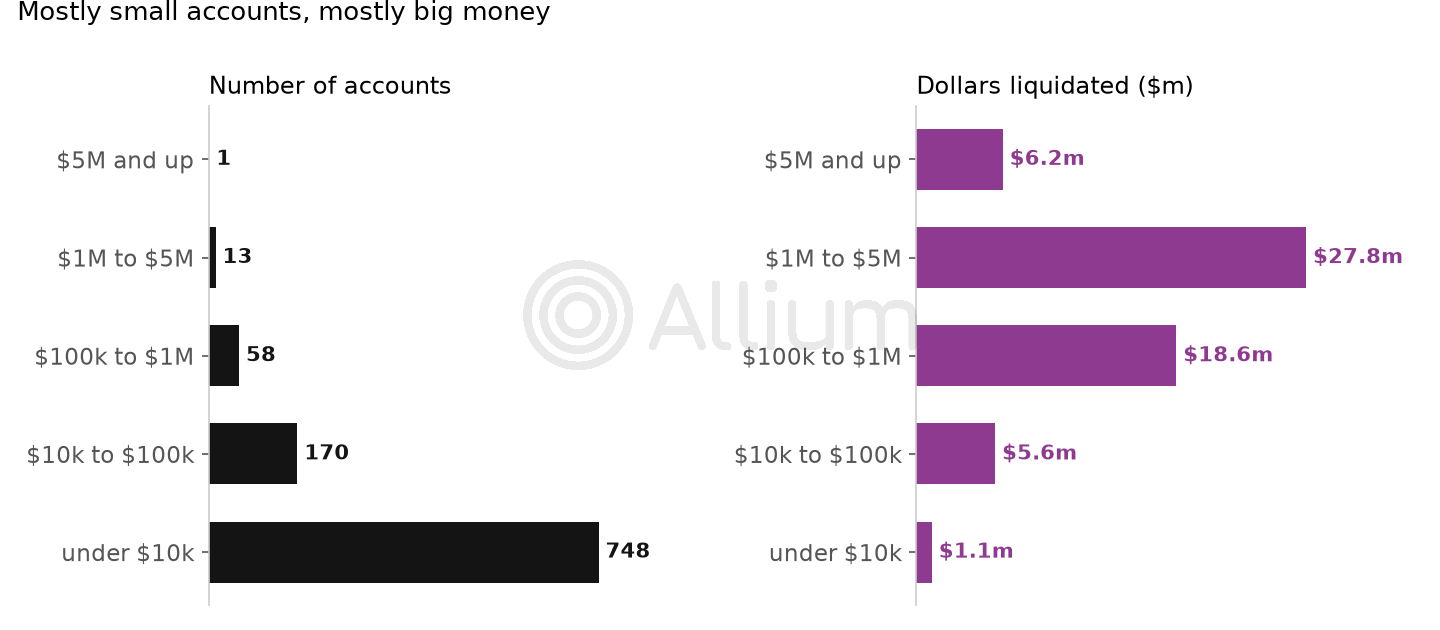
The losses were concentrated in a handful of accounts, though most of the accounts were small.
748 of the 990 were under $10,000 and lost $339,000 between them. Fourteen accounts at $1 million or more carried 57% of the total. The median account lost about $1,000, against an average of $59,892.
Trade.xyz said it will cover liquidation losses attributable to the anomalous portion of the move, and that it is reviewing how prices are formed, “including revisiting assumptions on external venues.” Usage has not suffered, and 29 July was the contract’s busiest day since it launched, at $1.74 billion in volume, with open interest back to roughly $542 million.
All onchain figures are derived from Allium's Hyperliquid dataset and cover the SK Hynix perpetual (ticker xyz:SKHX), tracking one KRX common share converted into US dollars. Percentage moves therefore include the won to dollar rate; use the KRX prints in won for a clean move in the shares. Liquidation totals count each liquidated position once, filtered to the liquidated account's own fill, and exclude the protocol's backstop vault. Peer comparisons use xyz:MU (Micron), xyz:DRAM (one share of the Roundhill Memory ETF), xyz:NVDA and xyz:TSM. Korean pre-market session hours and the venue attribution come from public exchange schedules and Trade.xyz's public statements. Informational only. Not investment advice.
do you have classes for new students who are interested in crypto?